Product design · Innovation · Relationship technology
Moxii
A design investigation into how people form relationships in the real world, and what technology can do to support that process rather than replace it.
- Figma
- Design concept
- UX research
The problem
Most dating apps are built around the same assumption: keep people on the platform as long as possible. That is a business model, not a product philosophy, and it produces apps that are very good at generating engagement and very bad at helping people actually meet.
The design literature on relationship formation is clear on a number of things that the major apps consistently ignore: propinquity (the role of proximity in attraction), the way shared activity reduces social anxiety at early stages, and the fact that the “match” is not the moment of connection, it is a hurdle before connection. Apps that treat the match as the destination create a product loop that serves retention rather than the user.
The approach
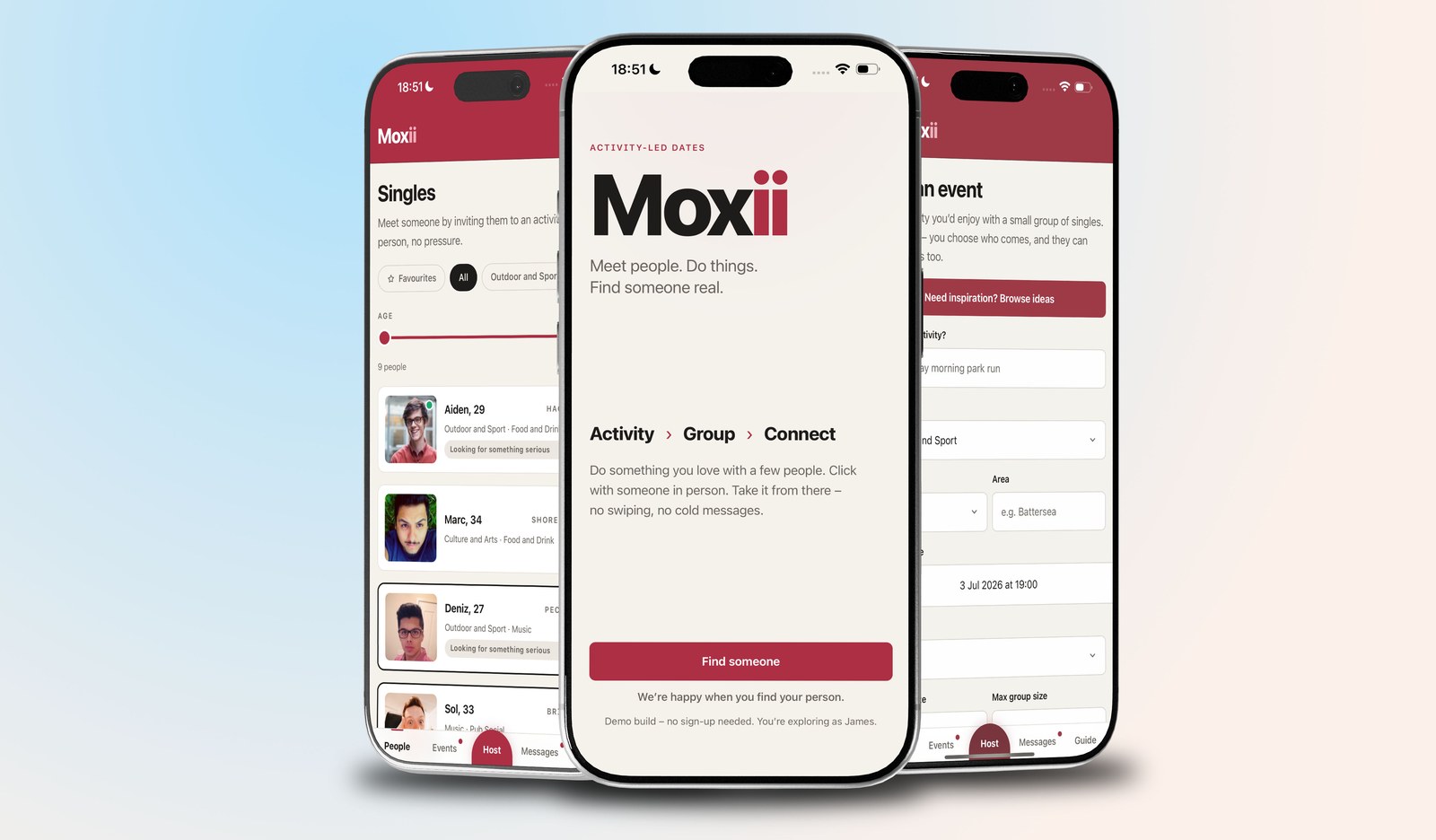
Moxii is a design investigation into what a dating app would look like if it were built around the moment two people decide to meet, rather than the moment they match. The core question is: what does the product architecture look like when the goal is a real-world encounter rather than an in-app conversation?
The answer produces a product that looks nothing like the incumbents. Rather than an infinite deck of profiles, a mutual-intention system. Rather than a chat interface designed to extend in-app time, a coordination layer designed to make meeting easy. Rather than notifications optimised for return visits, signals oriented towards the user’s real-world calendar.
The outcome
The project serves as a portfolio piece demonstrating innovation in a crowded category, how first-principles thinking about a well-understood social problem leads to a product architecture that incumbents are structurally unable to build because their business model depends on the problem persisting.